
Canada's Housing Recovery Is Coming — But Don't Expect a BoomWhat RBC's Latest Forecast Means for Buyers and Sellers in 2026-2027If you've been waiting for a sign that the Canadian housing

Dated: December 12 2025
Views: 273
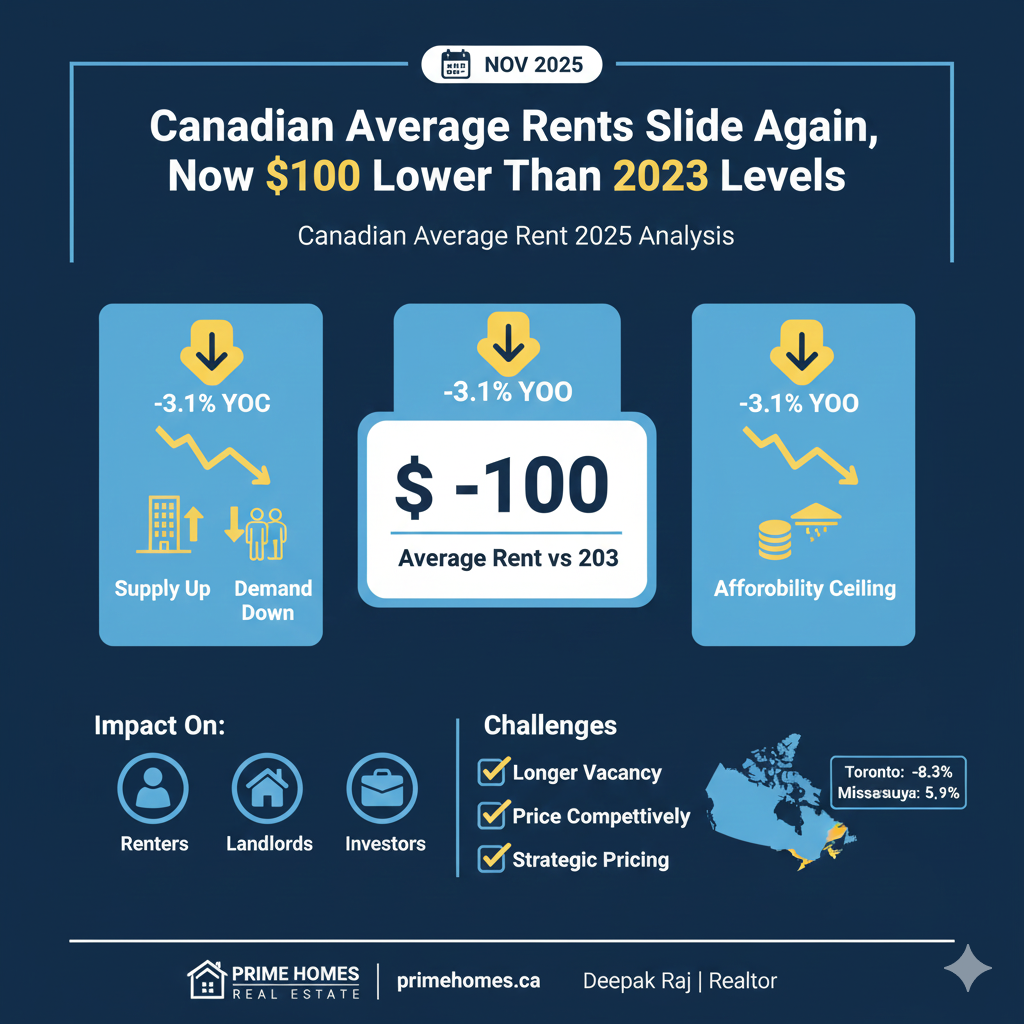
Canadian Average Rents Slide Again, Now $100 Lower Than 2023 Levels
By Deepak Raj | Realtor | primehomes.ca
Canadian rents have continued their downward trend through late 2025, marking the 14th straight month of annual declines. According to multiple national rent reports, the average asking rent now sits around $2,074, representing a 3.1% year-over-year drop and roughly $100 below 2023 levels.
This decline is driven by three major forces:
Supply is finally catching up, with a wave of purpose-built rentals and condo completions adding competition.
Population growth and migration have moderated, softening demand.
Affordability ceilings are binding, preventing landlords from pushing prices higher.
For renters, this shift brings more selection, better incentives, and stronger negotiating power.
For landlords and investors, especially in Ontario and the GTA, it signals the need for strategic pricing, conservative forecasting, and hands-on management.
This Canadian average rent 2025 analysis explains why rents are falling, how much they’ve dropped, and what the numbers mean for renters, buyers, sellers, and investors—particularly in Southern Ontario.
Where relevant, this article references and internally links to other primehomes.ca resources, including:
GTHWA Homeowner Sentiment After the June 4, 2025 BoC Rate Hold
What Is the Current Real Estate Market Like – Southern Ontario 2025 Update
June 2025 Market Update
May 2025 Market Update
April 2025 Market Update
Because supply has increased at the same time demand has softened, creating more vacancy, more competition, and less pricing power for landlords.
📌 1. Surge in new purpose-built rental and condo supply
Government data and national rent reporting platforms confirm that multiple years of new construction completions have begun hitting major urban markets simultaneously.
New buildings in transit-oriented corridors are creating a more competitive environment across:
Toronto
Metro Vancouver
Calgary
Montreal
Ottawa
Hamilton-Burlington
Kitchener-Waterloo
📌 2. Slower population growth & migration
After record immigration and interprovincial migration in 2022–2024, population growth in 2025 has moderated.
Fewer new arrivals means fewer households competing for rental units.
📌 3. Economic uncertainty reducing household formation
Reports show a rise in:
roommates pairing up
tenants delaying moves
young adults staying with family
households downsizing in expensive cities
📌 4. Affordability ceilings limiting further rent increases
Rents rose far faster than wages from 2020–2023.
Now, in markets like Toronto and Vancouver, tenants simply cannot absorb further increases, forcing landlords to adjust.
Current national average asking rent: ~$2,074
Year-over-year change: -3.1%
Total decline vs. late 2023: Approximately $100
Streak: 14 consecutive months of annual declines
| Property Type | Average Asking Rent | Annual Change |
|---|---|---|
| Purpose-built rentals | ~$2,060 | ~-2% |
| Condo rentals | ~$2,157 | ~-3.7% |
| 1-Bedroom | Declining | More pronounced |
| 2-Bedroom | Declining | Steepest in Toronto |
| 3-Bedroom+ | Mixed | Some markets resilient |
| Region / City | Latest Trend |
|---|---|
| Canada Overall | 3.1% annual drop to ~$2,074 |
| B.C. Province | ~-6.4% YoY |
| Alberta Province | ~-4.3% YoY |
| Ontario Province | ~-3.5% YoY |
| Calgary | ~-5.9% YoY |
| Montreal | ~-3.3% YoY |
| Ottawa | ~-0.7% YoY |
| Toronto (2-beds) | ~-8.3% YoY |
| Vancouver (3-beds) | ~-8.8% YoY |
Despite the decline, large metros such as Vancouver, Toronto, and parts of the GTA remain hundreds of dollars above the national average.
Rents in the GTA have decreased across most segments:
One-bedroom condo rents: Down ~5% YoY
Two-bedroom units in Toronto: Down ~8.3%
Downtown vacancy rates: Gradually rising
MLS rental listings: Increasing, giving renters more choice
Cities showing the greatest declines:
Downtown Toronto
North York
Etobicoke
Mississauga City Centre
Vaughan Metropolitan Centre
These trends complement insights from the internal blog What Is the Current Real Estate Market Like – Southern Ontario 2025 Update.
Mississauga and Brampton have seen:
Higher vacancy
More investor-owned condos hitting the market
Stronger competition for tenants
Richmond Hill, Markham, Newmarket, and Aurora show:
Modest declines in average rents
Growth in purpose-built rental supply
Stable demand for family-sized units
Oshawa and Whitby remain relatively affordable but have also seen:
A drop in condo rental rates
More tenant negotiation on price
Oakville and Burlington maintain some of the higher suburban rents but:
Two-bedroom units have softened
Leasing periods are longer than in 2023–24
CMHC’s rental data notes:
Rising vacancy
Tenants choosing between competing new builds
Kitchener, Waterloo, and Cambridge have:
High rental stock due to student-oriented development
Slight rent declines as supply increases
Across major cities, vacancy rates have moved off their record lows.
Even small increases in vacancy exert significant downward pressure on asking rents.
There is a multi-year pipeline of new rentals completing:
High-rise purpose-built projects
Investor-owned condos
Transit-oriented developments
Markets once chronically undersupplied are now experiencing temporary oversupply.
Population growth has normalized after hitting record levels between 2022–2024.
Persistent cost-of-living pressures and employment uncertainty are shaping tenant behaviour.
Households in expensive cities have reached a point where rent increases outpaced income growth, forcing a correction.
More inventory and better choice
Fewer bidding wars
Greater negotiating power
More incentives, including:
One month free
Parking discounts
Flexible lease terms
Renters considering long-term planning should also review the May 2025 Market Update and June 2025 Market Update.
Longer vacancy periods
Pressure to price units competitively
Higher carrying costs due to elevated interest rates
Need to offer incentives to attract quality tenants
Landlords with variable-rate mortgages or new purchases should:
Reassess cash flow models
Stress test against flat rents through 2026
Investors active in Southern Ontario should focus on:
Transit-rich, employment-dense locations
Conservative rent growth assumptions
Hands-on management
Longer hold periods
In high-supply condo corridors, sharper pricing strategies are essential to achieve target returns.
Ontario rents are down about 3.5% year over year, with the GTA following a similar pattern.
Is it cheaper to rent or buy in Toronto 2025?
In many central neighbourhoods, renting remains financially cheaper, especially when factoring:
High interest rates
Mortgage payments
Condo fees
Property taxes
But in suburban and secondary GTA markets where home prices corrected more than rents, the rent-vs-buy decision is closer.
This aligns with insights from the internal article:
GTHWA Homeowner Sentiment After the June 4, 2025 BoC Rate Hold.
Most national housing and policy agencies suggest:
Continued softness through winter
Slight stabilization in spring/summer 2026
Longer vacancy periods in high-supply corridors
Population growth strengthens → demand rises
Interest rates fall → renters move to ownership, affecting supply and demand
Economic uncertainty persists → shared housing increases, lowering demand
The most likely scenario for 2026 is flat to mildly declining rents, with pockets of resilience in constrained markets.
Because supply has increased while demand has moderated, raising vacancy rates.
Approximately $100 lower based on national asking rent averages.
Yes, modestly, especially in winter 2025–26. Stabilization is more likely mid-2026.
Renting remains cheaper in many central Toronto neighbourhoods. Suburban buy-vs-rent math varies.
Landlords must adjust expectations, consider incentives, and prepare for longer leasing periods.
Yes. Focus on resilient locations, conservative rent assumptions, and longer hold periods.
They help new tenants but won’t fully resolve affordability issues without continued building.
In a market where Canadian average rent is down $100 since 2023 but still historically high, making informed decisions matters more than ever.
Deepak Raj provides:
Rent vs. buy financial modelling
Cost breakdowns for GTA neighbourhoods
Identification of areas where ownership is now competitive
Optimal pricing strategies
Guidance on incentives and tenant positioning
Vacancy risk assessments
Data-driven acquisition strategies
Neighbourhood-level rent and vacancy insights
Portfolio optimization based on GTA rental market trends 2025
Deepak combines public rent data, CMHC insights, and on-the-ground experience across Toronto, York Region, Peel, and Durham to deliver transparent, evidence-based support.
Canadian rents have finally cooled after years of aggressive increases.
With supply rising and demand moderating, renters have regained leverage, while landlords and investors must recalibrate strategies.
As we move into 2026, expect:
Flat to slightly lower rents in many markets
Higher vacancy in high-supply corridors
Stronger competition among landlords
Clear opportunities for strategic buyers and long-term investors
Southern Ontario remains one of Canada’s most dynamic rental markets—successful navigation requires accurate data, local insight, and strategic guidance.
Whether you're renting, buying, selling, or investing, Deepak provides data-backed, neighbourhood-specific advice to help you make clear decisions in a shifting market.
📞 Call or text: 705-668-0297
📧 Email: primehomesto@gmail.com
🌐 Visit: primehomes.ca
Your next best move starts with accurate insight. Let’s plan it together.

Deepak Raj is a professional Real Estate Agent in Newmarket with Royal Canadian Realty, proudly serving home buyers, sellers, investors, and business owners across Newmarket, Aurora, Markham, Stouffvi....
Canada's Housing Recovery Is Coming — But Don't Expect a BoomWhat RBC's Latest Forecast Means for Buyers and Sellers in 2026-2027If you've been waiting for a sign that the Canadian housing
GTA & York Region Real Estate Market Update: August 2026What the latest TRREB numbers mean in Newmarket, Aurora, Markham, Vaughan, Simcoe County and across Southern OntarioBy Deepak Raj, Realtor
Newmarket Market Data · July 2026How Long Does It Really Take to Sell a House in Newmarket?2026 Market Data, Neighbourhood-Level Days on Market & What It Means for Your SaleQuick AnswerAs
Deepak Raj Realtor Royal Canadian Realty, BrokerageBook a Free ConsultationUnderstanding your Buyer Representation Agreement before you sign matters as much as the offer itself.Ontario Buyer's&

The listing data displayed is deemed reliable but is not guaranteed accurate by CREA®. Data last updated on September 22, 2026 11:33 PM UTC The trademarks REALTOR®, REALTORS®; and the REALTOR® logo are controlled by The Canadian Real Estate Association (CREA®) and identify real estate professionals who are members of CREA®. Used under license. The trademarks MLS®, Multiple Listing Service® and the associated logos are owned by The Canadian Real Estate Association (CREA®) and identify the quality of services provided by real estate professionals who are members of CREA®. Used under license.
Show More...
 Data provided by the Ontario Regional Technology & Information Systems. The information is deemed reliable, but is not guaranteed. Not intended to solicit buyers or sellers, landlords or tenants currently under contract.
The trademarks REALTOR®, REALTORS® and the REALTOR® logo are controlled by The Canadian Real Estate Association (CREA) and identify real estate professionals who are members of CREA. The trademarks MLS®, Multiple Listing Service® and the associated logos are owned
by CREA and identify the quality of services provided by real estate professionals who are members of CREA. Used under license.
REALTOR® contact information provided to facilitate inquiries from consumers interested in Real Estate services. Please do not contact the website owner with unsolicited commercial offers.
Show More...
Data provided by the Ontario Regional Technology & Information Systems. The information is deemed reliable, but is not guaranteed. Not intended to solicit buyers or sellers, landlords or tenants currently under contract.
The trademarks REALTOR®, REALTORS® and the REALTOR® logo are controlled by The Canadian Real Estate Association (CREA) and identify real estate professionals who are members of CREA. The trademarks MLS®, Multiple Listing Service® and the associated logos are owned
by CREA and identify the quality of services provided by real estate professionals who are members of CREA. Used under license.
REALTOR® contact information provided to facilitate inquiries from consumers interested in Real Estate services. Please do not contact the website owner with unsolicited commercial offers.
Show More...