
Canada's Housing Recovery Is Coming — But Don't Expect a BoomWhat RBC's Latest Forecast Means for Buyers and Sellers in 2026-2027If you've been waiting for a sign that the Canadian housing

Dated: March 7 2026
Views: 3978
A data-driven analysis of Ontario's shifting buyer demographics — and what it means for anyone planning to purchase their first home in 2026 and beyond.
If it feels like buying a first home in Ontario takes longer than it used to, the data confirms it. Multiple national housing surveys and Ontario-focused market studies — including data cited by the Canada Mortgage and Housing Corporation (CMHC), Statistics Canada, and the Canadian Real Estate Association (CREA) — point to a clear and striking trend: the median age of a first-time home buyer in Ontario is now approximately 36–40 years old as of 2026, with many buyers in the Greater Toronto Area completing their first purchase closer to age 40.
This represents a dramatic shift from just a decade ago, when Ontario buyers typically entered the market in their late 20s or early 30s. The "buy your first place at 28" milestone is now the exception, not the rule — particularly in high-demand markets across Southern Ontario.
| Metric | Ontario (2026) | Canada Average |
|---|---|---|
| Average first-time buyer age | 36–40 | 34–36 |
| Buyers under age 30 | ~20–25% | ~30–35% |
| Buyers aged 35+ | ~55% | ~45% |
| Typical household type | Dual-income couple | Dual-income couple |
| Typical household income | $120K–$180K | $95K–$130K |
Ontario and British Columbia now rank as the provinces with the oldest first-time home buyers in Canada — and among the oldest in the developed world — driven by sustained price-to-income gaps that require many households to save for additional years before qualifying.
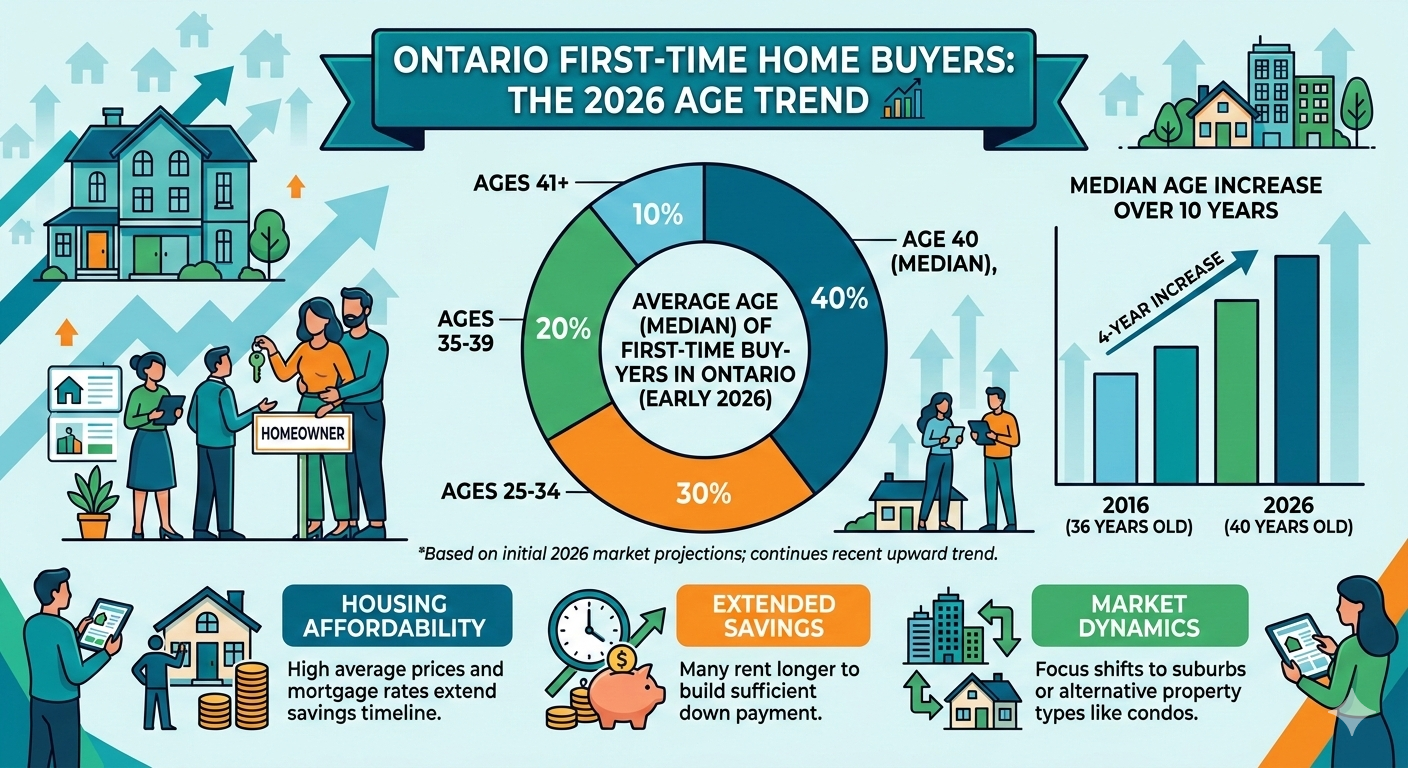
Over roughly the past 15 years, the age profile of Ontario's first-time buyers has climbed steadily and significantly. The sharpest acceleration came during the 2016–2022 housing boom, when prices in the Greater Toronto Area surged — in some markets, more than doubling — while wage growth lagged well behind.
The data is unambiguous: Ontario's first-time buyers are, on average, four to five years older today than they were a decade ago. Put in concrete terms, someone who would have purchased their first home at 33 in 2015 would, under today's conditions, more likely wait until 38 or 39.
The "average age 40" figure masks significant variation across Ontario's diverse markets. In the GTA's core, buyers routinely reach their late 30s or early 40s before making their first purchase. Move farther from the urban core, and the entry age drops meaningfully.
| Province | Average Age | Key Driver |
|---|---|---|
| Ontario | 36–40 | High price-to-income ratios, GTA premiums |
| British Columbia | 36–39 | Vancouver market pressure |
| Alberta | 32–34 | More accessible price points, strong wages |
| Quebec | 32–34 | Rent culture, later ownership transition |
| Atlantic Canada | 31–33 | Lower home prices, smaller urban centres |
Several interconnected forces have combined to push Ontario's first-time buyer age upward. Understanding these drivers is the first step toward developing a strategy to get into the market sooner.
Toronto home prices rose from ~$622K in 2015 to over $1.1M in 2024. Wage growth simply could not keep pace, requiring many additional years of savings to meet down payment thresholds.
Federal qualifying rules require buyers to qualify at a rate higher than their actual contract rate, reducing purchasing power — a constraint that disproportionately affects younger buyers with shorter income histories.
Graduate degrees, longer education timelines, and student loan repayment delay the accumulation of savings and the income stability lenders look for when approving mortgages.
Marriage, children, and long-term career commitments — historically the triggers for home purchases — are happening later, pushing the first purchase date further into buyers' 30s and beyond.
Many newcomers rent for several years to establish credit, secure employment, and save a down payment — entering the ownership market later than Canadian-born peers, reinforcing the upward age trend especially in GTA markets.
Insurance premiums, property taxes, utilities, and rate-increase periods have all elevated the income and savings bar required to comfortably sustain homeownership, pushing marginal buyers into a "wait and save" holding pattern.
| Market | Avg. Price 2015 | Avg. Price 2024 | Change |
|---|---|---|---|
| Toronto | $622K | $1.1M | +77% |
| York Region | $720K | $1.25M | +74% |
| Durham Region | $450K | $850K | +89% |
National mortgage surveys and CMHC's first-time buyer data paint a consistent portrait of today's typical Ontario buyer. The profile has shifted significantly from the single young professional of 20 years ago.
| Characteristic | Typical Profile |
|---|---|
| Age | 35–40 |
| Household type | Dual-income couple |
| Household income | $120K–$180K |
| Down payment | $80K–$200K |
| Primary property type | Condo or condo townhouse |
| Geographic preference | Suburban or secondary market |
| Property Type | Typical Buyer Age | Notes |
|---|---|---|
| Condo Apartment | 28–35 | Primary GTA entry point; lower down payment |
| Condo Townhouse | 30–36 | Balance of space and affordability |
| Freehold Townhouse | 32–38 | Popular in suburban and secondary markets |
| Semi-Detached | 34–40 | Common in Durham, Hamilton, and Waterloo |
| Detached Home | 36–42 | Rare as a first home in major markets |
Single buyers still enter the market but face substantially greater hurdles in high-cost areas. Dual-income households benefit from pooled income and savings — an increasingly important structural advantage in today's qualification environment.
Federal and provincial governments have introduced several tools to help first-time buyers. While these do not fully offset broader affordability pressures, they can meaningfully reduce the time needed to save and qualify — potentially moving your purchase date earlier by months or even years.
Tax-deductible contributions of up to $8,000/year (lifetime max $40,000), with tax-free withdrawals when purchasing a qualifying first home. One of the most impactful tools available to first-time buyers since its 2023 launch.
Allows first-time buyers to withdraw up to $60,000 from their RRSP tax-free for a home purchase. Combined with the FHSA, this can significantly boost the down payment available.
Provides up to $1,500 in tax relief in the year of purchase — a modest but meaningful contribution toward closing costs for eligible buyers.
Ontario and Toronto offer rebates on land transfer taxes for qualifying first-time buyers, potentially saving several thousand dollars at closing — funds that can be redirected to strengthen your down payment.
Looking ahead, economists and housing analysts project two distinct scenarios based on how key variables evolve.
If mortgage rates normalize, housing supply increases meaningfully in high-demand areas, and wage growth continues, the median first-time buyer age could plateau in the late-30s range. Government programs like the FHSA are also incrementally improving the savings equation for younger buyers.
If housing supply remains constrained, rates stay elevated for longer than expected, or policy interventions fail to move the needle on affordability, the average age could continue drifting toward — and potentially past — 40 as the new normal. In that environment, younger Ontarians may increasingly explore co-buying, secondary markets, or alternative property types as viable paths to first ownership.
The gap between "average" and "achievable" is precisely where strategy matters most. The same market conditions that push the average buyer age to 40 can be navigated by an informed buyer to achieve ownership in their early-to-mid 30s — with the right plan, the right market, and the right guidance.
Understanding these statistics is one thing — building a personalized strategy that moves your purchase date earlier is another. Deepak Raj Realtor works with first-time buyers across York Region, the GTA, Peel, Hamilton-Burlington, and Waterloo to turn homeownership from a distant goal into a defined, achievable plan.
By analyzing your income, existing debts, current savings rate, and available mortgage products, you can understand precisely how soon you can buy — and at what price point. This turns a vague "someday" into a clear, actionable timeline. Many buyers are surprised to learn they can purchase sooner than they thought.
First-time buyers frequently leave programs on the table because they are unaware of how to stack and combine them. A focused strategy can help you use the FHSA, Home Buyers' Plan, insured low-down payment mortgages, and land transfer tax rebates effectively — potentially bringing your first purchase date forward by a year or more.
Not every Ontario submarket requires a 40-year-old buyer. With deep local knowledge across Southern Ontario's diverse markets — from Durham's more accessible entry points to emerging communities in Waterloo Region and Hamilton — the right first property can be found at the right stage of your financial journey. Based on buyer discussions across York Region and Newmarket, many first-time buyers are surprised by how much purchasing power they have when targeting the right markets and property types strategically.
Ontario's housing market moves quickly, and first-time buyers rarely get multiple attempts in a short window. Data-driven guidance on comparable sales, offer strategy, and market timing can mean the difference between overpaying and buying smart — protecting your investment from day one.
Even in today's market, buying earlier is possible with the right strategy. Let Deepak Raj Realtor build a personalized plan that brings your first purchase date forward — across York Region, GTA, Peel, Hamilton, and Waterloo.

Deepak Raj is a professional Real Estate Agent in Newmarket with Royal Canadian Realty, proudly serving home buyers, sellers, investors, and business owners across Newmarket, Aurora, Markham, Stouffvi....
Canada's Housing Recovery Is Coming — But Don't Expect a BoomWhat RBC's Latest Forecast Means for Buyers and Sellers in 2026-2027If you've been waiting for a sign that the Canadian housing
GTA & York Region Real Estate Market Update: August 2026What the latest TRREB numbers mean in Newmarket, Aurora, Markham, Vaughan, Simcoe County and across Southern OntarioBy Deepak Raj, Realtor
Newmarket Market Data · July 2026How Long Does It Really Take to Sell a House in Newmarket?2026 Market Data, Neighbourhood-Level Days on Market & What It Means for Your SaleQuick AnswerAs
Deepak Raj Realtor Royal Canadian Realty, BrokerageBook a Free ConsultationUnderstanding your Buyer Representation Agreement before you sign matters as much as the offer itself.Ontario Buyer's&

The listing data displayed is deemed reliable but is not guaranteed accurate by CREA®. Data last updated on September 22, 2026 11:33 PM UTC The trademarks REALTOR®, REALTORS®; and the REALTOR® logo are controlled by The Canadian Real Estate Association (CREA®) and identify real estate professionals who are members of CREA®. Used under license. The trademarks MLS®, Multiple Listing Service® and the associated logos are owned by The Canadian Real Estate Association (CREA®) and identify the quality of services provided by real estate professionals who are members of CREA®. Used under license.
Show More...
 Data provided by the Ontario Regional Technology & Information Systems. The information is deemed reliable, but is not guaranteed. Not intended to solicit buyers or sellers, landlords or tenants currently under contract.
The trademarks REALTOR®, REALTORS® and the REALTOR® logo are controlled by The Canadian Real Estate Association (CREA) and identify real estate professionals who are members of CREA. The trademarks MLS®, Multiple Listing Service® and the associated logos are owned
by CREA and identify the quality of services provided by real estate professionals who are members of CREA. Used under license.
REALTOR® contact information provided to facilitate inquiries from consumers interested in Real Estate services. Please do not contact the website owner with unsolicited commercial offers.
Show More...
Data provided by the Ontario Regional Technology & Information Systems. The information is deemed reliable, but is not guaranteed. Not intended to solicit buyers or sellers, landlords or tenants currently under contract.
The trademarks REALTOR®, REALTORS® and the REALTOR® logo are controlled by The Canadian Real Estate Association (CREA) and identify real estate professionals who are members of CREA. The trademarks MLS®, Multiple Listing Service® and the associated logos are owned
by CREA and identify the quality of services provided by real estate professionals who are members of CREA. Used under license.
REALTOR® contact information provided to facilitate inquiries from consumers interested in Real Estate services. Please do not contact the website owner with unsolicited commercial offers.
Show More...