


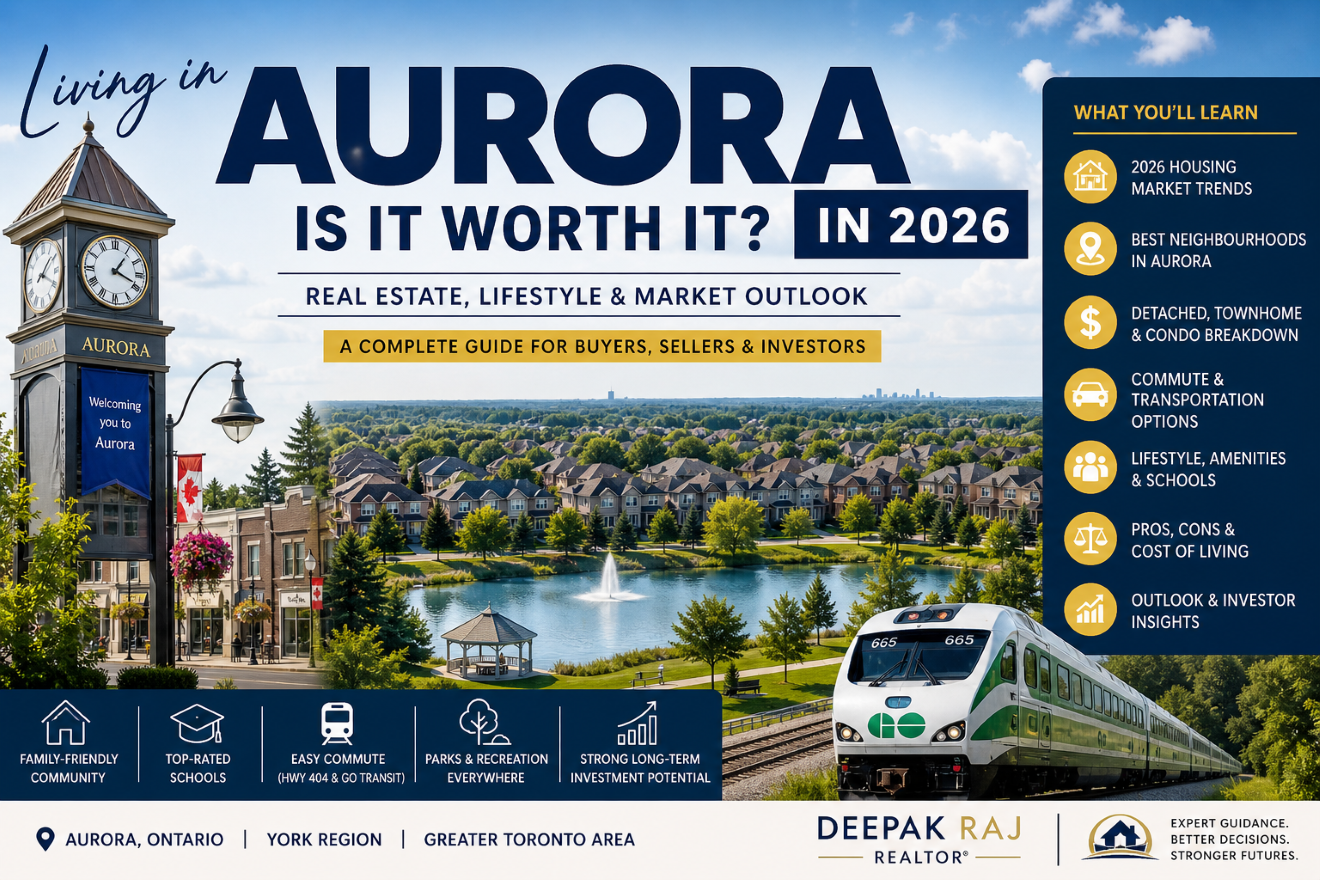
If you're searching "Is Aurora a good place to live in 2026?" — you're in the right place. Aurora is absolutely worth it in 2026… if you value lifestyle, space, and long-term stability over cheap entry pricing. Here's the full breakdown so you can make a real decision.
What Makes Aurora Stand Out in 2026?
Aurora sits in the sweet spot most buyers are chasing but struggling to find: close enough to Toronto to be practical, far enough to breathe, and established enough to feel like a real community rather than a speculative gamble.
Commute Access
Highway 404 direct to Toronto, Markham, and Vaughan. Aurora GO Station with weekday & weekend service.
Schools & Healthcare
Strong public and private school options. Southlake Regional Health Centre serves the community.
Lifestyle
Quiet, family-friendly streets with parks, trails, and community events — small-town feel with urban access.
Population & Growth
62,000+ residents (2021 Census). Steady, real-demand growth rather than speculative expansion.
| Feature | Aurora Advantage |
|---|---|
| Commute | HWY 404 + GO Transit → Toronto in ~35 min |
| Lifestyle | Quiet, family-friendly, safe neighbourhoods |
| Housing | More space vs. downtown Toronto at same price |
| Schools | Strong local school reputation |
| Growth | Stable, fundamentals-driven — not speculative |
Is Aurora Expensive in 2026?
Short answer: Yes. But not blindly expensive.
Aurora is not a budget market — it is a value-for-lifestyle market. Publicly available 2026 estimates place average Aurora home values in the low-to-mid seven-figure range, with condos substantially lower and detached homes commanding the highest prices.
Buyers in Aurora aren't paying for square footage alone — they're paying for location, school access, and neighbourhood quality. That's a different kind of investment.
If you're hunting purely for "cheap," Aurora will frustrate you. But if your question is "Where will my family actually thrive?" or "Where will my equity hold over time?" — Aurora starts making a great deal of sense.

Aurora, Ontario — Real Estate, Lifestyle & Market Outlook for Buyers, Sellers & Investors in 2026
Not sure if Aurora fits your budget?
Explore our Zero Down Program and Rent-to-Own Program — two pathways that help buyers get into the market with less upfront.
Which Aurora Neighbourhoods Are Best?
Stop looking for "the best neighbourhood" in general terms — that's how people overpay. Instead, match the area to your specific situation and lifestyle needs.
Bayview Northeast & Aurora Heights
- Newer home builds
- Schools nearby
- Parks & community feel
- Move-up buyer sweet spot
Established Central Aurora
- Mature neighbourhoods
- Quiet, walkable streets
- Easy healthcare access
- Southlake proximity
Rural Aurora Edges
- Larger lots
- Lower density
- Peace and privacy
- Space for home businesses
How Is the Commute from Aurora?
This is where Aurora quietly wins over most of its competitors in the region.
Aurora is about 35 km north of Toronto, connected by Highway 404 and the Aurora GO Station with weekday and weekend service, free parking, and commuter-oriented amenities. Best for hybrid workers, remote workers, and 2–3 day commuters.
The honest caveat: if you are commuting downtown five days a week, you will feel it. But for the growing segment of buyers working on hybrid schedules, Aurora's commute profile is genuinely strong — and the lifestyle trade-off is often worth it.
Aurora Housing Market Breakdown (2026)
Aurora in 2026 is not a runaway seller's market. It's something smarter: a selective, buyer-aware market where inventory levels give buyers real negotiating room, while steady demand from families and move-up buyers keeps values supported.
| Property Type | Market Behaviour | Best For |
|---|---|---|
| Detached | Strong demand, premium pricing | Upgrading families |
| Semi-Detached | Balanced demand | Mid-range move-up buyers |
| Townhomes | High demand, faster sales | First-time buyers |
| Condos | Entry-level option | Investors & downsizers |
How Aurora Compares Regionally
Aurora competes directly with Richmond Hill, Markham, and Newmarket — not with cheaper outer markets. Here's how it stacks up across Southern Ontario:
| Region | Affordability | Lifestyle | Demand |
|---|---|---|---|
| Toronto | Low | Urban, dense | Very high |
| Peel Region | Moderate | Mixed | High |
| York Region (Aurora) | Moderate–High | Family-focused, stable | Steady |
| Durham Region | More affordable | Growing | Rising |
| Halton Region | High | Premium suburbs | Strong |
| Hamilton-Burlington | Moderate | Value-driven | Growing |
| Waterloo Region | Moderate | Tech-driven | Strong |
Who Should Move to Aurora in 2026?
✅ Best Fit for Aurora
- Families upgrading from condos
- Buyers prioritizing schools & safety
- Hybrid & remote workers
- Long-term homeowners
- Downsizers wanting stability
⚠️ Aurora May Not Be the Right Fit If…
- Budget is the primary driver
- Chasing quick speculation flips
- Wanting nightlife & urban density
- Need lowest-possible entry price
What About Investors?
Aurora is not a high-risk, high-reward speculative play — and that's actually a good thing for the right investor mindset.
The best Aurora investment strategy focuses on end-user demand: family-friendly rentals, stable tenants, and long-term appreciation driven by real lifestyle need. Think steady growth, not speculation cycles.
Market Outlook for Aurora in 2026
Aurora's strength is its consistency. The market rewards buyers and investors who understand fundamentals over hype. Key signals heading through 2026:
Buyers have more negotiating power than peak years. Pricing is tied to real demand from families and lifestyle-driven buyers. If mortgage conditions continue to ease through the Bank of Canada's rate cycle, Aurora is positioned to benefit steadily — not explosively, but reliably.
Aurora holds value through quality-of-life demand rather than hype cycles. In uncertain markets, that's exactly what you want behind your investment.
First Time Buying in Aurora?
Download our First-Time Home Buyer Guide — plain-language advice on navigating Aurora's market without overpaying or missing better opportunities.
Frequently Asked Questions
These are the questions Aurora buyers and sellers ask most — answered directly.
Is Aurora a good place to live in Ontario?
Yes — Aurora consistently ranks among York Region's most desirable communities. It offers strong schools, a safe environment, excellent commute access via Highway 404 and GO Transit, and a family-friendly atmosphere that holds value over time. It is best suited for buyers who prioritize quality of life and long-term stability.
Is Aurora expensive compared to Toronto?
Aurora is slightly more affordable than central Toronto but still a premium suburb. Average home values in 2026 sit in the low-to-mid seven-figure range. The key difference is what you get for your money — more space, a quieter environment, and better schools at a price point that still exceeds more affordable outer-GTA alternatives.
Can first-time buyers afford Aurora in 2026?
It is possible but challenging. Townhomes and condos are the most realistic entry points for first-time buyers. Programs like the Zero Down Program and Rent-to-Own Program offered through PrimeHomes.ca can help bridge the gap for qualified buyers who don't yet have a full down payment.
Is Aurora good for commuting to Toronto?
Yes — especially for hybrid and flexible workers. Aurora GO Station provides weekday and weekend service with free parking. Highway 404 connects you to Toronto, Markham, and Vaughan. The town is approximately 35 km north of Toronto. Daily five-day downtown commuters will feel the distance; two-to-three day commuters typically find it very manageable.
Will Aurora home prices rise in 2026?
Steady, modest appreciation is the most likely scenario — driven by real lifestyle demand rather than speculation. If Bank of Canada rate conditions continue to ease, Aurora is well-positioned to benefit. Buyers should focus on value by neighbourhood, home type, and condition rather than assuming uniform appreciation across all properties.
What are the best neighbourhoods in Aurora for families?
Bayview Northeast and Aurora Heights are most commonly sought by move-up family buyers — they offer newer homes, proximity to schools, parks, and a strong community feel. Established central Aurora suits downsizers, while rural Aurora edges suit buyers seeking larger lots and more privacy.
Ready to Make Your Move in Aurora?
Most buyers either overpay for the wrong street, miss better opportunities nearby, or wait too long and chase the market. You don't need more information — you need better interpretation. That's where Deepak Raj comes in.


 Data provided by the Ontario Regional Technology & Information Systems. The information is deemed reliable, but is not guaranteed. Not intended to solicit buyers or sellers, landlords or tenants currently under contract.
The trademarks REALTOR®, REALTORS® and the REALTOR® logo are controlled by The Canadian Real Estate Association (CREA) and identify real estate professionals who are members of CREA. The trademarks MLS®, Multiple Listing Service® and the associated logos are owned
Data provided by the Ontario Regional Technology & Information Systems. The information is deemed reliable, but is not guaranteed. Not intended to solicit buyers or sellers, landlords or tenants currently under contract.
The trademarks REALTOR®, REALTORS® and the REALTOR® logo are controlled by The Canadian Real Estate Association (CREA) and identify real estate professionals who are members of CREA. The trademarks MLS®, Multiple Listing Service® and the associated logos are owned