


If you've been searching "moving to Woodland Hill Newmarket 2026," you're likely after more space, newer homes, better schools, or a genuine escape from Toronto prices. As of early 2026, Woodland Hill has become one of the most sought-after neighbourhoods in Newmarket for families, GTA movers, and long-term investors — offering highway access, GO Transit, parks, top-rated schools, and newer housing stock in a single well-organized community.
This guide breaks down everything you need to know before making your move — from real pricing data and market conditions to school catchments, commute realities, and who this neighbourhood actually suits.
Is Woodland Hill a Good Place to Live in 2026?
Yes — here's the snapshot every buyer needs before going deeper.
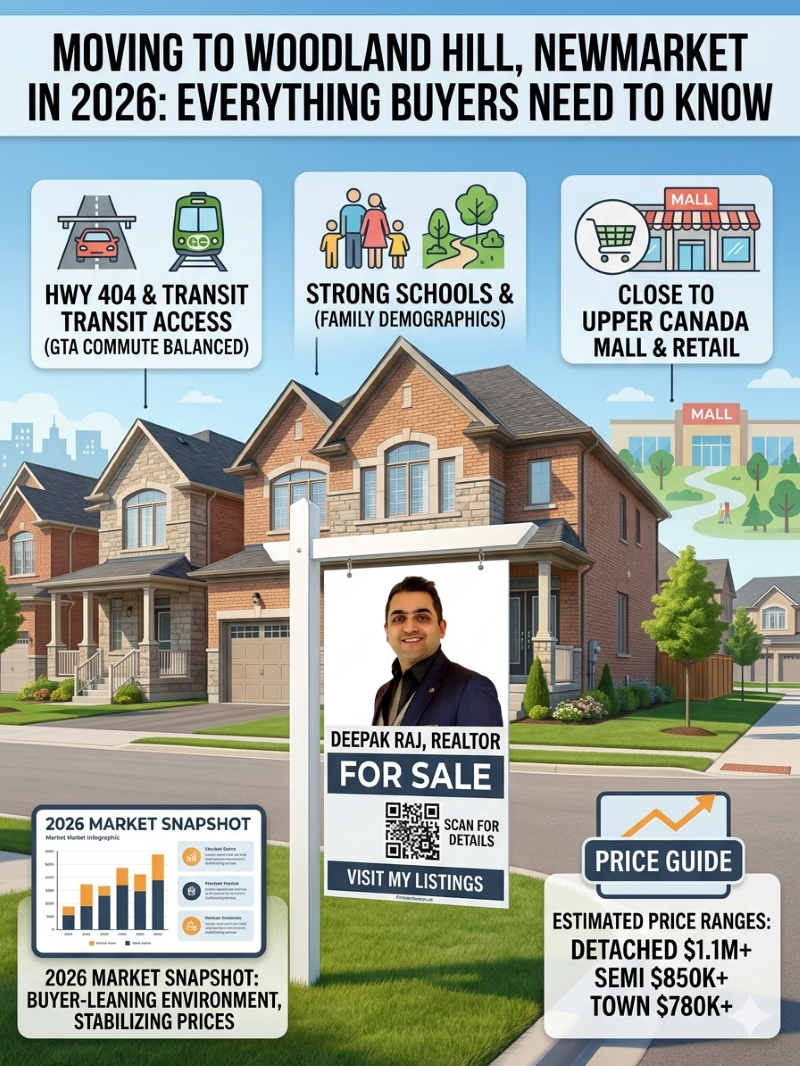
Market conditions as of early 2026: Buyer-leaning environment · Prices below 2025 peak · Month-over-month recovery beginning · Improved negotiating leverage
Best fit for:
Where Is Woodland Hill in Newmarket?
Woodland Hill sits in the northwest corner of Newmarket, anchored along Yonge Street with Green Lane to the south. A pair of stone markers on the west side of Yonge at Aspenwood Drive marks the formal neighbourhood entrance — giving the community a defined sense of place that buyers consistently notice when comparing Newmarket options.
The neighbourhood is immediately north and west of Upper Canada Mall, with Green Lane providing quick access to Highway 404 and neighbouring East Gwillimbury. For GTA movers, Woodland Hill's position at the junction of Newmarket, East Gwillimbury, and the HWY 404 corridor is a genuine commuter advantage.
Nearby Landmarks & Amenities
Woodland Hill Real Estate Prices in 2026
Woodland Hill's housing stock is primarily mid-2000s construction — large single detached homes, semi-detached homes, and freehold townhomes, with detached properties accounting for over 80% of sales in recent datasets. This translates to modern floor plans, attached garages, finished basements, and open-concept layouts that appeal strongly to families and hybrid workers.
Newmarket's median sale price in early 2026 sits around $940,000, down roughly 7–8% year-over-year from the 2025 peak, but up more than 5% month-over-month — suggesting an early-cycle transition toward stabilization. Woodland Hill homes typically track at or slightly above town averages due to newer stock and proximity to amenities.
Is Woodland Hill a Buyer's Market in 2026?
Technically yes — but not uniformly across all property types. Newmarket's sales-to-new-listings ratio sits in the low-30% range with months of inventory in the mid-4s, giving buyers more negotiating room than during the 2021–2022 frenzy. That said, well-priced detached homes near parks and top school catchments still attract meaningful competition.
Housing Types at a Glance
Detached Homes: Dominant inventory with 3–5 bedrooms, double garages, finished basements, and open layouts. Most appealing to move-up buyers leaving condos or smaller GTA homes.
Townhomes: The most popular entry point — lower maintenance, freehold ownership options, and strong rental demand make them ideal for first-time buyers and investors.
Semi-Detached: Less common but highly competitive, sitting between affordability and square footage. Move quickly when priced correctly.
Condos: Limited within Woodland Hill itself. Buyers seeking condo apartments typically explore nearby Newmarket nodes.
What Is Daily Life Like in Woodland Hill?
Woodland Hill consistently punches above its weight on daily convenience. Immediate adjacency to Upper Canada Mall and the Yonge–Green Lane big-box corridor means residents are within minutes of Walmart, Home Depot, Winners, major grocery stores, fitness centres, restaurants, and coffee shops — reducing the need to leave the neighbourhood for everyday errands.
Parks & Recreation
The neighbourhood includes multiple parks, trails, and green spaces purpose-built for family life: Environmental Park, the Dave Kerwin Trail, and Woodland Hill Labyrinth Park, which runs through the centre of the community with walking paths, play structures, and gathering areas. Families with kids of all ages — from toddlers to teenagers — are strongly represented in the local demographic profile.
Dining, Healthcare & Entertainment
Healthcare is well-served by Southlake Regional Health Centre a short drive away, along with a growing cluster of medical offices across Newmarket. For dining and entertainment, residents enjoy both chain restaurants near Upper Canada Mall and the independent eateries and boutiques along historic Main Street Newmarket — providing suburban convenience plus genuine neighbourhood character.
Are There Good Schools in Woodland Hill?
Yes — Woodland Hill falls within well-regarded catchment areas connected to both the York Region District School Board and the York Catholic District School Board, providing access to English public and Catholic elementary and secondary options. Multiple Newmarket schools score above provincial averages on standardized metrics, and school capacity has grown alongside the neighbourhood's development.
Beyond academics, families are drawn to Woodland Hill's safe, low-traffic internal streets, abundance of playgrounds, newer homes with larger yards, and proximity to organized sports and recreation programs offered by the Town of Newmarket. For parents relocating from denser Toronto neighbourhoods, the quality-of-life upgrade is immediately tangible.
Is Woodland Hill Good for Commuters?
Yes — particularly for hybrid workers. Woodland Hill's proximity to Highway 404 via Green Lane, Yonge Street transit corridors, and GO Transit access via Newmarket GO Station creates a solid commuter base. Peak-hour commute times into central Toronto employment areas typically fall in the 60–75 minute range by a combination of bus and GO rail, with off-peak under an hour.
Notably, Newmarket has one of the highest "live-to-work" ratios in York Region — meaning many Woodland Hill residents also work locally, keeping commutes short or nonexistent for those employed within the town.
| Destination | Estimated Commute Time |
|---|---|
| Richmond Hill | 25–40 minutes |
| Markham | 35–50 minutes |
| Vaughan | 35–50 minutes |
| Downtown Toronto | 60–75 minutes |
| East Gwillimbury | 10–15 minutes |
| Aurora / Newmarket Core | 10–20 minutes |
Who Should Move to Woodland Hill?
Living in Woodland Hill: The Honest Trade-Offs
✅ Pros
- 🏗️ Newer housing stock (mid-2000s) with modern layouts and brick construction — lower near-term maintenance vs. older in-town areas.
- 🛍️ Unmatched shopping access via Upper Canada Mall and the Yonge/Green Lane retail corridor — daily errands are minutes away.
- 🌳 Family-oriented layout with multiple parks, trails, playgrounds, and well-regarded school catchments.
- 🚗 Strong HWY 404 and GO Transit connectivity for GTA commuters and hybrid workers.
- 📊 Buyer-leaning 2026 conditions provide more negotiating room and fewer bidding wars than peak years.
❌ Cons
- 🏛️ Uniform newer housing stock — buyers seeking heritage character homes or large lots should look to central Newmarket or surrounding communities.
- 🚦 Yonge Street and Green Lane arterials can experience traffic congestion, especially near the retail corridor during peak hours.
- 💰 Homes backing onto green space or within top school catchments command premium pricing even in a buyer-leaning market.
- 🏢 Limited condo inventory within the neighbourhood — buyers seeking condo apartments will need to look at nearby Newmarket nodes.
Is 2026 a Good Year to Buy in Newmarket?
Potentially yes — especially for buyers with a long-term horizon. Newmarket and broader York Region moved from the intense 2021–2022 seller's market into a buyer-leaning environment through 2025 and into 2026. By early 2026, several indicators (months of inventory, SNLR, days on market) suggest the deepest correction is behind us.
What this means for Woodland Hill buyers: More inventory and choice, fewer extreme bidding wars, room to negotiate conditions and closing dates, and pricing that still reflects the broader Newmarket correction — while momentum rebuilds month over month.
From a macro lens, housing starts in Ontario are expected to remain constrained through 2026. Combined with continued GTA-to-York-Region population migration, this sets the stage for renewed upward price pressure over the medium term. Buyers who secure homes in Woodland Hill in 2026 may benefit from locking in ahead of the next sustained upswing — provided financing is in order and the time horizon is 5–7+ years.
How Newmarket Compares to Other Ontario Regions
| Region | 2026 Market Trend | Primary Buyer |
|---|---|---|
| Toronto | Expensive; slower luxury activity | Condo buyers |
| Peel Region | Competitive family market | Move-up buyers |
| York Region | Stabilizing with improving momentum | Families |
| Durham Region | Affordability-driven demand | First-time buyers |
| Halton | Premium suburban pricing | Professionals |
| Hamilton-Burlington | Investor activity stabilizing | Hybrid commuters |
| Waterloo Region | Tech-driven sustained demand | Professionals & investors |
Zero Down Program & Rent-to-Own Available
Not everyone has a 20% down payment ready. Deepak Raj's exclusive programs help qualified buyers get into the Newmarket market today — without waiting years to save.
Frequently Asked Questions: Woodland Hill Newmarket 2026
Is Woodland Hill Newmarket a good investment?
Yes. Woodland Hill offers newer freehold homes, stable family rental demand, and proximity to major retail and transit. It is generally viewed as a solid long-term hold for both end-users and investors — more suited to stable appreciation than speculative flipping.
What is the average house price in Woodland Hill?
As of early 2026, detached homes typically exceed $1.1M, semis range from $850K–$1M, and freehold townhomes start around $780K–$950K. Condos in nearby Newmarket areas begin in the mid-$400,000s. Exact pricing should be verified using the latest TRREB data at time of purchase.
Is Newmarket cheaper than Toronto?
Generally yes. Buyers can secure larger, newer detached homes in Newmarket for comparable or lower budgets than similar Toronto properties, particularly when comparing freehold housing. The value-per-square-foot advantage remains meaningful in 2026.
Is Woodland Hill a buyer's market in 2026?
Yes — Newmarket remains buyer-leaning in early 2026 with improved inventory and negotiating leverage. However, well-located detached homes near parks and top schools continue to attract stronger interest, so "buyer's market" doesn't mean every property is up for grabs.
Are there good schools in Woodland Hill Newmarket?
Yes. Woodland Hill falls within well-regarded York Region District School Board and York Catholic District School Board catchments. Multiple Newmarket schools score above provincial averages, and both English public and Catholic options are accessible from the neighbourhood.
Is Woodland Hill good for commuters?
Yes. Highway 404 access via Green Lane, Yonge Street transit corridors, and Newmarket GO Station make it a strong option for both daily Toronto commuters (60–75 min peak) and hybrid workers who only travel a few days per week.
What are the best neighbourhoods in Newmarket?
It depends on your priorities. Woodland Hill leads for families seeking newer homes and retail convenience. Central Newmarket suits buyers wanting heritage character and walkable main street amenities. Stonehaven-Wyndham and Glenway Estates appeal to buyers seeking executive-style homes.
Are there condos in Woodland Hill?
Woodland Hill itself is dominated by freehold detached, semi-detached, and townhomes. Buyers seeking condo apartments typically look just beyond the immediate neighbourhood at Newmarket's broader condo nodes.
Deepak Raj
Buying in Woodland Hill requires more than scrolling listings and hoping for the best. Micro-neighbourhood differences matter — some streets attract stronger resale demand, some school catchments outperform others, and some homes appear well-priced until you compare recent conditional sales and local inventory patterns. That's where York Region expertise becomes genuinely valuable.
Deepak Raj specializes in Woodland Hill, Newmarket, and broader York Region real estate, offering first-time buyer guidance, GTA relocation support, negotiation strategy in shifting markets, and access to off-market opportunities. Serving buyers, sellers, and investors across York Region, Peel, Waterloo, and Hamilton-Burlington.
Ready to Explore Woodland Hill?
Get hyper-local pricing insights, street-by-street guidance, and a strategy tailored to where the 2026 market is heading. Book a free 30-minute consultation with Deepak Raj.


 Data provided by the Ontario Regional Technology & Information Systems. The information is deemed reliable, but is not guaranteed. Not intended to solicit buyers or sellers, landlords or tenants currently under contract.
The trademarks REALTOR®, REALTORS® and the REALTOR® logo are controlled by The Canadian Real Estate Association (CREA) and identify real estate professionals who are members of CREA. The trademarks MLS®, Multiple Listing Service® and the associated logos are owned
Data provided by the Ontario Regional Technology & Information Systems. The information is deemed reliable, but is not guaranteed. Not intended to solicit buyers or sellers, landlords or tenants currently under contract.
The trademarks REALTOR®, REALTORS® and the REALTOR® logo are controlled by The Canadian Real Estate Association (CREA) and identify real estate professionals who are members of CREA. The trademarks MLS®, Multiple Listing Service® and the associated logos are owned