


Ontario Real Estate & Tenancy GuideN11 and N12 in Ontario: What Every Landlord and Tenant Needs to Know in 2026By Deepak Raj, REALTOR® | Royal Canadian Realty, Brokerage |
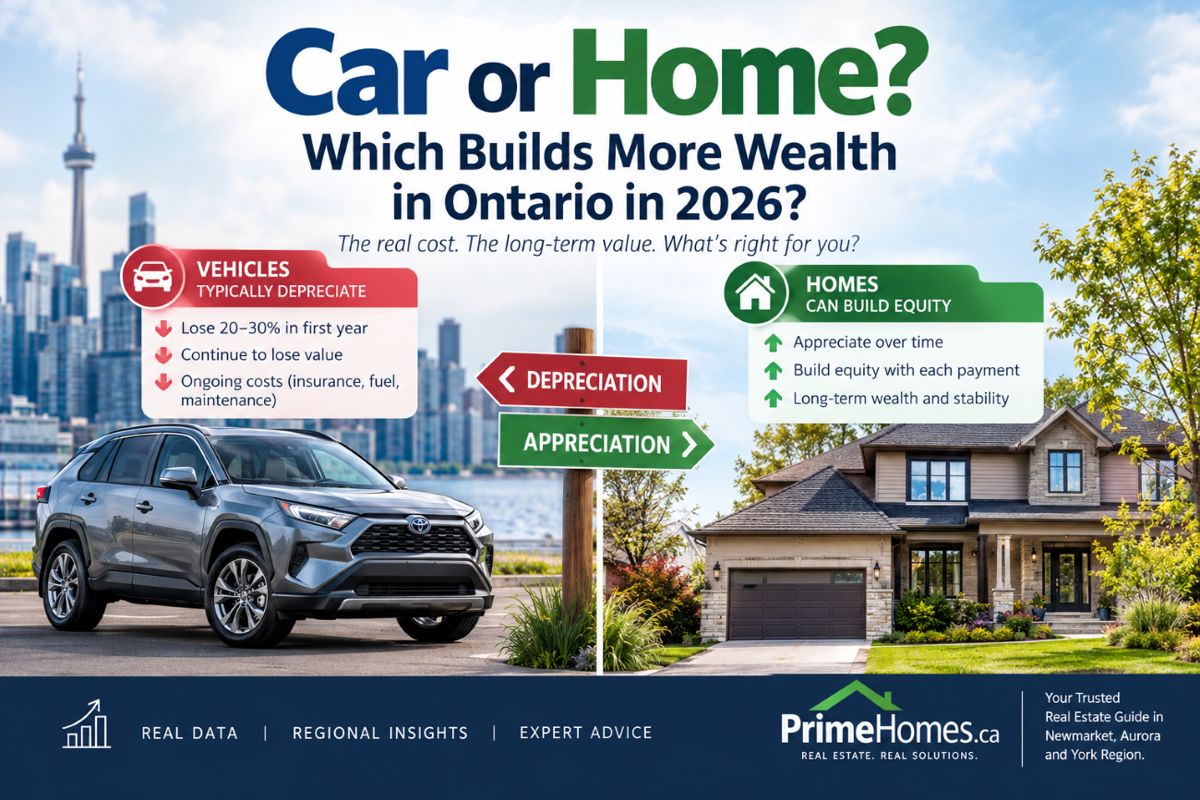
Short answer: generally, a home has greater wealth-building potential than a car, because residential real estate can appreciate over time while a new vehicle typically loses 20% to 30% of its value in the first year. Your income, debt, down payment, location and time horizon still decide whether buying makes sense for you.
Should you buy a new car or put that money toward a home? For many Ontario households in 2026, that question is really about how your money behaves over time. A new vehicle offers comfort, reliability and technology, but financially it is generally a depreciating asset. A home is different: part of each mortgage payment can build equity, and if the property appreciates over the long term, your ownership stake can grow with it. That does not make every home a good investment, but if your objective is long-term wealth building, the numbers are worth comparing.
🏡 Is a Home a Better Wealth-Building Asset Than a Car?
Generally, yes. Statistics Canada puts Canadian household net worth at about $19.1 trillion in Q2 2026, with household residential real estate valued at about $8.52 trillion. It remains one of the largest components of household wealth. A vehicle, by contrast, normally loses value the day it leaves the lot.
| Purchase | Typical financial behaviour |
|---|---|
| 🚗 New vehicle | Depreciates |
| 🏠 Residential property | Can appreciate over time |
| 🚗 Auto loan | Pays down debt against a declining asset |
| 🏠 Mortgage | Pays down debt while building ownership equity |
| 🚗 Insurance, fuel, maintenance | Ongoing consumption costs |
| 🏠 Property expenses | Ongoing ownership costs, but tied to an asset |
Cars are not “bad”; for many families they are essential. The question is whether a major vehicle upgrade should come before building a stronger financial foundation through ownership.
🚗 How Much Does a New Car Really Cost in Ontario?
The average new vehicle in Canada sold for just over $63,000 in Q2 2026, and average new-vehicle loan payments reached more than $806 per month. Add insurance, fuel, maintenance, repairs, winter tires, registration, parking, financing interest and depreciation, and a $63,000 vehicle costs considerably more over a five-year loan. You can pay off the entire loan and still own an asset worth far less than you paid.
🏠 How Does a Mortgage Build Wealth Differently?
Each mortgage payment splits into interest and principal, and principal repayment increases your ownership stake. If the home's value also rises, equity grows from two directions: mortgage principal reduction + property appreciation = potential equity growth. Buy at $700,000, pay the balance down and see the value rise, and your equity can end up far larger than your original down payment.
Real estate does not rise every month or every year, and there is no guaranteed appreciation. Statistics Canada reported household residential real estate up 0.4% quarter over quarter to $8.5233 trillion in Q2 2026, still 0.3% below a year earlier. The wealth-building case rests on long-term ownership and equity, not short-term price gains.
Not sure how much home your budget supports?
Deepak will walk you through prices, payments and closing costs for your target area.
Call 647-560-0965📊 What Does the Ontario Housing Market Look Like in 2026?
The 2026 market looks very different from the frenzy of 2021 and early 2022. According to TRREB's August 2026 Market Watch:
- GTA average selling price: $993,410, down 2.7% year over year
- MLS® HPI Composite benchmark: down 4.5% year over year
- GTA home sales: 5,057, down 2.1%
- New listings: 12,075, down 14.1%; active listings down 11.3%
Buyers have more negotiating room than during the boom, but supply is tightening. The better question is not “Will prices go up?” but “Can I comfortably afford a home that fits my long-term financial plan?”
📍 Where Are Homes More Accessible Across Southern Ontario?
| Area | August 2026 average price |
|---|---|
| Newmarket | $1,048,321 |
| Aurora | $1,105,004 |
| Markham | $1,208,692 |
| Vaughan | $1,234,758 |
| Mississauga | $898,510 |
| Brampton | $886,865 |
| Burlington | about $1.02M to $1.05M |
| Pickering | $935,490 |
| Whitby | $905,123 |
| Ajax | $871,853 |
| Oshawa | $652,775 |
| Clarington | $733,960 |
| Hamilton | $736,731 |
| Kitchener-Waterloo-Cambridge | $722,351 |
Ontario is not one housing market. Toronto, Peel, York, Durham, Halton, Hamilton-Burlington and Waterloo differ widely in affordability and inventory, so a detached house in Newmarket is not the only route to ownership.
🏘️ Which Housing Type Makes Sense for a First-Time Buyer?
- Detached: the highest prices, for land, privacy and space. The GTA average detached price in August 2026 was about $1.29 million.
- Semi-detached: more affordable access to established neighbourhoods, with land ownership.
- Freehold townhouse: a middle ground between affordability and space, and worth serious consideration.
- Condo apartment: often the lowest purchase price. Toronto new condominium apartment prices have declined since Q1 2025, which may create a more accessible entry point.
The key calculation is the total monthly carrying cost: mortgage, property taxes, insurance, utilities and, where applicable, maintenance fees.
💰 Should You Put $60,000 Toward a Car or a Home?
Option A: buy a $60,000 vehicle and own a depreciating asset. Option B: put some or all of that capital toward a home, where it becomes part of an asset that can appreciate while the mortgage is paid down.
A large car payment also affects mortgage qualification, because lenders count existing debt obligations. So an expensive vehicle does not just consume cash; it can reduce your future borrowing capacity. If you plan to buy within one to three years, that deserves serious thought.
📉 Are Mortgage Rates Still Reasonable in Ontario in 2026?
The Bank of Canada held its overnight rate at 2.25% on September 2, 2026, with the next announcement on October 28, 2026. Mortgage rates, especially fixed rates, can move independently of that rate. Qualify on a payment you can afford today; any future improvement is a bonus, not the foundation of your decision.
👨👩👧 What Does This Mean for First-Time Homebuyers?
For first-time buyers in Newmarket, Aurora and the wider GTA, five questions decide it:
- Can I qualify for the mortgage?
- Can I afford the monthly payment comfortably?
- Do I have enough cash for the down payment and closing costs?
- Will I stay long enough to justify buying?
- Will I still have room for emergencies and normal life?
If the answers are yes, putting every spare dollar into a luxury vehicle may deserve a second look. You do not need the biggest or a perfect house, just one that fits your finances and your life.
📈 What About Real Estate Investors?
A rental can generate rental income, principal repayment, long-term appreciation, tax considerations and diversification. It also brings mortgage costs, property taxes, maintenance, insurance, vacancy, management, condo fees, repairs and selling costs. Real estate does not always go up, so the numbers have to work: estimate rent, vacancy, financing, operating expenses and resale value before buying in Newmarket, Aurora, Durham, Peel, Hamilton-Burlington or Waterloo.
🏡 What Does This Mean for Sellers?
Buyers weigh a housing payment against vehicle payments, childcare, food, insurance, credit cards, student loans and taxes, which makes accurate pricing more important in 2026. With the GTA average at $993,410, down 2.7% from a year earlier, you cannot price off what a neighbour got at the peak. Value depends on location, condition, housing type, comparable sales and current competition. For Newmarket sellers, days on market and neighbourhood-level comparables matter most; PrimeHomes.ca's recent Newmarket analysis found sharp differences between detached, semi-detached, townhouse and condo properties.
📍 What About Newmarket and York Region?
Newmarket suits buyers seeking family housing, established neighbourhoods and GTA access. Its August 2026 average of about $1,048,321 was up 5.3% year over year, while Aurora averaged about $1,105,004 and Markham and Vaughan topped $1.2 million. See our Newmarket and Aurora area pages for more. If detached is out of reach, consider semi → townhouse → condo → a different municipality rather than new car → wait → keep renting → hope housing gets cheaper. The second path can work, but it should rest on numbers, not assumptions.
Want a Newmarket, Aurora or York Region price check?
Email Deepak your target area and budget for current comparable sales and a realistic monthly-cost estimate.
Email Deepak❓ Frequently Asked Questions: Car vs. Home in Ontario
Is buying a home better than buying a car for building wealth?
Generally, yes. Residential real estate has greater long-term wealth-building potential because homes can appreciate while vehicles normally depreciate. Your income, debt, down payment, location and time horizon still decide whether a specific purchase makes sense.
Does a car loan build equity?
Technically, yes. Paying down principal increases your ownership share. But the vehicle itself generally loses value, so the equity is being built against a depreciating asset.
How quickly does a new car lose value?
New vehicles can lose approximately 20% to 30% of their value in the first year, followed by further annual depreciation.
Is 2026 a good year to buy a home in Ontario?
Buyers have more negotiating room than at the peak. TRREB reported the GTA average price was $993,410 in August 2026, down 2.7% year over year, while new listings fell 14.1% and inventory is tightening. Affordability for your own budget is the deciding factor.
Is Newmarket a good place to buy a home?
Newmarket's August 2026 average price was approximately $1,048,321, up 5.3% year over year. Whether a specific property makes sense depends on price, condition, neighbourhood, financing and how long you plan to stay.
Should I buy a car before buying a house?
If the vehicle creates a large monthly debt payment or uses cash you need for a down payment and closing costs, it can make home ownership harder. Lenders count car payments when assessing mortgage affordability.
What should I do with $50,000 to $60,000 if I want to build wealth?
There is no universal answer. Compare emergency savings, debt repayment, investment options and the capital needed for a realistic home purchase, ideally with a mortgage professional.
Should I wait for mortgage rates to fall?
Waiting only for a rate cut can be risky, because rates, prices, inventory and your circumstances can all change. The Bank of Canada held its policy rate at 2.25% on September 2, 2026; the next announcement is October 28, 2026.
🔗 Keep Reading on PrimeHomes.ca
- August 2026 GTA & York Region Real Estate Market Update
- How Long Does It Really Take to Sell a House in Newmarket?
- April 2026 Southern Ontario Market Update, May 2026 GTA Market Update and June 2026 GTA Market Update
📌 Final Thoughts: Car or Home?
A car can make your life easier. A home can potentially build your net worth. If your current vehicle is unsafe or essential for work, replacing it may be necessary. But if you are choosing between a $60,000 vehicle and your first home, the long-term consequences deserve a serious look.
In 2026, Ontario buyers have more choice than during the pandemic-era frenzy: prices are below the 2022 peak and some GTA markets offer negotiating room. Supply is also tightening, so waiting indefinitely for the perfect moment is not a strategy either. Don't only ask “Can I afford the payment?” Ask “What will this purchase do to my wealth over the next 5, 10 or 20 years?”
Thinking about buying in Newmarket, Aurora or York Region?
Deepak Raj, Realtor® with Royal Canadian Realty, helps first-time, move-up, newcomer, self-employed and investor clients understand what they're buying, what they're paying, and how it fits their long-term financial plan.
Deepak@royalcanadianrealty.com | PrimeHomes.ca
Serving Newmarket, Aurora, York Region and communities across the GTA and Southern Ontario.
Because a vehicle gets you somewhere. A well-chosen home can help build where you're going.
Sources: TRREB Market Watch, August 2026; Statistics Canada National Balance Sheet Accounts, Q2 2026; Bank of Canada; AutoTrader Price Index; Canadian Black Book. General information only, not financial or mortgage advice. Averages describe past sales and do not predict any individual property's value.

 Data provided by the Ontario Regional Technology & Information Systems. The information is deemed reliable, but is not guaranteed. Not intended to solicit buyers or sellers, landlords or tenants currently under contract.
The trademarks REALTOR®, REALTORS® and the REALTOR® logo are controlled by The Canadian Real Estate Association (CREA) and identify real estate professionals who are members of CREA. The trademarks MLS®, Multiple Listing Service® and the associated logos are owned
Data provided by the Ontario Regional Technology & Information Systems. The information is deemed reliable, but is not guaranteed. Not intended to solicit buyers or sellers, landlords or tenants currently under contract.
The trademarks REALTOR®, REALTORS® and the REALTOR® logo are controlled by The Canadian Real Estate Association (CREA) and identify real estate professionals who are members of CREA. The trademarks MLS®, Multiple Listing Service® and the associated logos are owned